Showing posts with label pixel art. Show all posts

Pixel Art - Part 2 of 2

The Spartan
The Spartan (above) by Telemachus Stavropoulos aka Helm uses a limited colour palette comprised only of black, red, green and blue (zoom in if you don't believe me) blended together to synthesise a greater variety of colours and tones. You might be aware that most colour computer screens (be they CRT, LCD, plasma display or LED display) use a similar method to display anything. Separate red, blue and green light sources comprise each pixel and are seen as a single colour by the human eye. Every pixel in The Spartan is either one of these coloured light sources at its full intensity, or black, the absence of any colour at all. Helm describes his work better than I could:

"It's an examination of what happens when clusters of these bright pixels come into various permutations to fake a fidelity that they'd be incapable of achieving alone. A holistic effect that occurs when all the disparate parts are acutely controlled. There is a beauty in this process for me that makes me return to this medium again and again."

The Spartan embodies ideas of purity in pixel art. Though Helm himself admits that the work is flawed, when I look at it I find many reasons to consider pixel art one of the most important media to arise through the development of technology. I love the idea of creation through limitation. Given that pixel art (like most digital media) is typically stored as discrete data, the number of possible combinations that can be made within given restrictions is finite. Thus, I would speculate that some level of perfection is possible. Pixels can be coloured; arranged; rearranged... and eventually a state will be reached where no greater combination of pixels can be made. That is an opinion I have sometimes, anyway.

For those interested, check out Helm's blog or his musings on pixel art.

As I plan to say no more about pixel art, I thought I'd close with a couple of my favourite works of pixel art by revered pixel artist Fool. Click to see them full size:


Pixel Art - Part 1 of 2

For a definition of pixel art, see the bottom of this post.


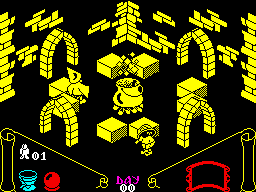
Above is an artwork by a group called eBoy who are among the most well known producers of pixel art. eBoy frequently use the technique of isometric projection in their pixel art, a technique that has had ties to pixel art since the early 80s due to video games such as Zaxxon and Knight Lore. An interesting result of this technique is the grid of cubes used to construct the architecture (and other aspects of the work) alludes to the grid of pixels the construction blocks are in turn constructed from.

I chose this image specifically because it depicts a physical representation of the Internet, featuring a number of popular websites... pretty suitable for this blog. I also wanted to talk about the communities centred around the creation and appreciation of pixel art (such as Pixel Joint) but I've already said way too much.

What is pixel art?

Pixel art is the construction of images at the pixel level. Pixels, for those who don't know, are tiny coloured squares arranged in a grid, often to form the visuals we see on computer monitors, mobile phones and other technological devices. What differentiates pixel art from other digital images is that each pixel is individually and manually chosen rather than relying on the technology to do the work (such as the algorithms of digital cameras, or the tools, techniques and filters of a program like Photoshop). In addition to this, a limited colour palette is often employed.

These conditions of pixel art were initially formed out of necessity, as early computers couldn't display the number of colours they now can. In addition to this, graphics had to be created manually, so there was often no alternative to pixel art. In this way all pixel art alludes to past technology. Pixel art is rarer now on personal computers due to a decreased need for such restrictions, but appears frequently on mobile phones and handheld gaming devices.